
Searching Montgomery County Criminal Dockets
Start at the official North Carolina eCourts Portal and open Smart Search. If you know the record number, type it in. Otherwise, search by defendant name. Set the location to Montgomery County. Treat criminal case criteria as a refinement rather than a first step. Advanced filters will not run on their own. What comes back is the Montgomery County Case Summary, also called the Register of Actions. It is the useful view because it organizes case information, events, hearings, dispositions, and financial information when applicable.
Search Hearings and the Montgomery County calendar do a different job. They confirm a current setting once you have found the right case, so a Montgomery County hearing check should start from the matching case instead of a general calendar result. The Portal is free, and registration is optional for public lookup. A registered account can save cases in My Cases, but it unlocks no restricted material and does not turn the Portal view into an official court record.
- Open Smart Search in the eCourts Portal and enter a record number or defendant name.
- Set the location to Montgomery, then add case type, status, or filing-date filters if they help narrow the result.
- Open the matching Montgomery County Case Summary and read the newest Case Event, Hearings entry, and any Disposition block.
- Use Search Hearings or the official Montgomery County criminal calendar to check a forthcoming setting.
- Contact the Montgomery County Clerk of Superior Court for a paper file, copy, or certification when the public view is incomplete.
The Portal landing page is where Montgomery County criminal docket searches begin from home.
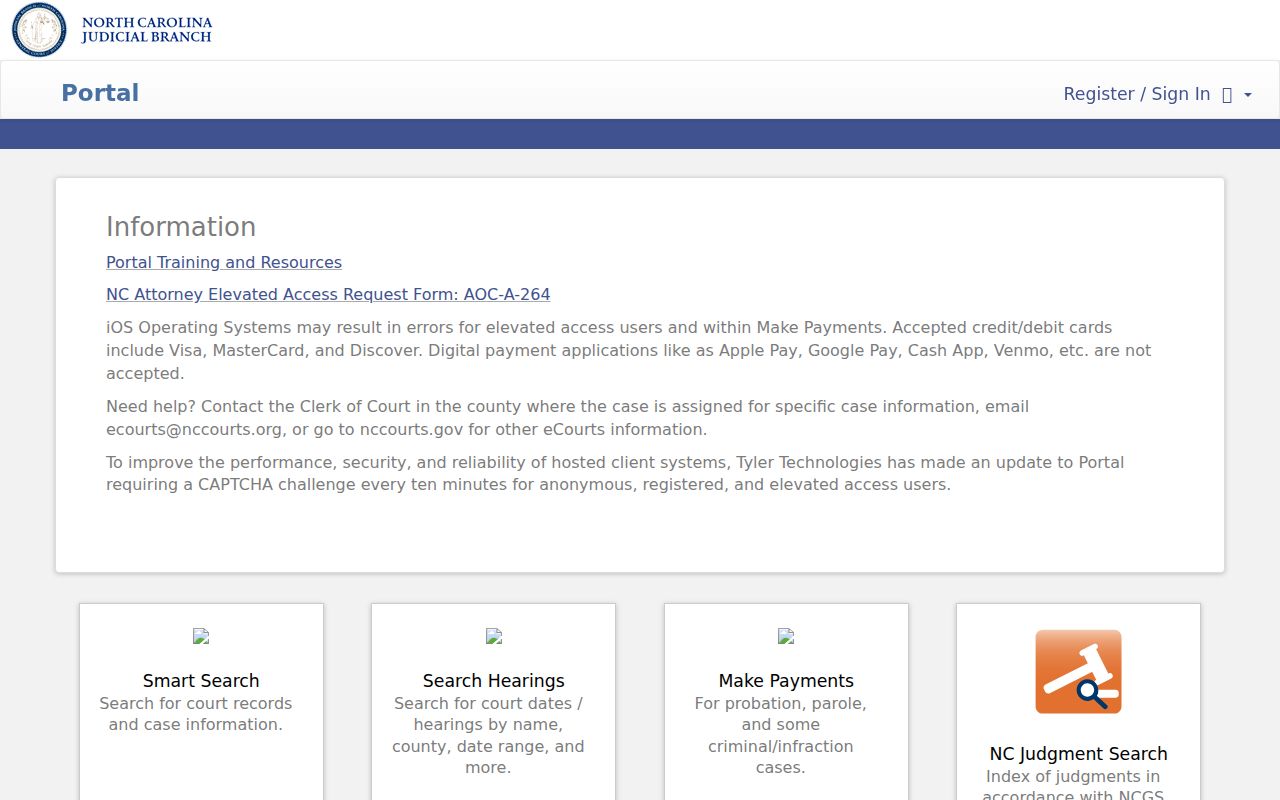
The Portal supplies the statewide search layer for a Montgomery County criminal lookup. It is not a separate Montgomery criminal clerk or municipal docket service.
Montgomery Criminal Record Numbers
A record number is usually the quickest route to a Montgomery County criminal Case Summary. Odyssey numbers follow a pattern: a two-digit year, case-type letters, a six-digit sequence, a hyphen. A three-digit county identifier completes it. Montgomery County's identifier is 610. The example 25CR000001-610 is made up just to show the pattern. It does not identify an actual case. Take the number from a notice, citation, prior court document, or Portal result. Do not construct one yourself.
The Portal cannot search Montgomery County criminal cases by charge. That limit matters when a broad term returns nothing usable. Reach for the record number first. With a name search, fill in the principal name field and keep the Montgomery County location selection in place. A last-name wildcard needs at least three characters before the asterisk. A first-name wildcard needs at least one character before the asterisk. Open a Montgomery County result before reading anything into its status. The record number also gives the Clerk a reliable starting point for a file question.
Note: A zero-result search can reflect a spelling issue, the wrong location, a restriction, or an older paper file. That is not proof that no case exists.
Inside a Montgomery County Criminal Docket
The Portal publishes a documented public schema for Montgomery County criminal Case Summaries. The view can show a record number, case and assignment information, party information, chronological Case Events, Hearings, Dispositions, and Financial Information when applicable. Public documents may appear after upload. An image is not promised for every Montgomery County event, though. Read the event date and description together. When timing matters, confirm the current hearing through Search Hearings.
| Record number | The case identifier, such as the fabricated format 25CR000001-610, used to retrieve the record. |
|---|---|
| Case information | Header-level information describing the criminal case and its available status details. |
| Assignment information | Court or judicial-assignment information when shown in the Case Summary. |
| Case events | The chronological Montgomery County register of public filings, notices, orders, or other documented actions. |
| Hearings | Scheduled proceedings that can also be checked through Portal Search Hearings. |
| Disposition | An outcome or case-end entry when recorded; it may not explain every condition or document. |
Charges, bond figures, attorney fields, attachments, courtroom details, and financial balances are not guaranteed in every Montgomery County public record, per the official documentation. When you need a certified record or a document missing from the public view, the Montgomery County Clerk holds the official case file. Treat a Case Summary as a public access view, not a substitute for that file.
Montgomery Criminal Status Labels
A status label is a brief system description, not the whole story. Read it beside the newest Montgomery County Case Event. Check any later Hearing and the Disposition block. Portal materials list several criminal statuses: Pending, Disposed, Completed, Archived, Remanded, Transfer to Another County, Transferred to Superior Court, Pending Expungement, and Voluntarily Dismissed with Leave. Labels never replace the actual Montgomery County event history.
- Pending
- The matter has not reached a final resolution in the listed court posture.
- Disposed
- A disposition has been recorded; the Case Summary and any official order provide needed context.
- Transferred to Superior Court
- A District Court matter has moved into the Superior Court path, including a criminal appeal situation.
- Pending Expungement
- A documented Portal status that does not establish whether public access remains available.
Portal training materials provide the statewide vocabulary for these labels. The court publishes no Montgomery County-specific list of event-code abbreviations, so full Portal labels beat guessed shorthand for a Montgomery County record.
How a Criminal Case Moves
A Montgomery County criminal record can begin with case information alone. It then gains events and hearing entries as the matter proceeds. No fixed Montgomery County sequence is published for every case. So read for the most recent event, any future hearing, and a disposition if one appears. A felony carries a Superior Court context. A misdemeanor or infraction normally begins in District Court. An appeal can later move the matter to Superior Court.
Criminal docket flow: Case initiation › Case Events › Hearing or setting › Later event or order › Disposition when recorded
A continuance is a postponement the court approves. Filing a request creates no outcome by itself. An older Montgomery County hearing sitting in the register can mislead, so run Search Hearings and check with the Clerk. That step points you to the current Montgomery County setting instead of an entry that no longer controls the case.
Montgomery Criminal Calendar Checks
Start with the Montgomery County Case Summary. It is the running register for the case. The Montgomery County criminal calendar is a separate public scheduling view. Pull the case first. Then compare its hearing information against the calendar whenever a date needs confirmation. A calendar snapshot never guarantees a setting will hold. Portal also stays silent on whether a hearing is remote or in person. Treat it as a scheduling aid rather than the final word on a court date.
Search Hearings takes a case number. It also searches by party, business, attorney, judicial officer, or courtroom. The Montgomery County courtroom clerk controls the actual call order. Sorting a result may tidy your check. It cannot tell you the order in which a judge will call cases from the docket.
For a county-scoped scheduling route, use the official Montgomery criminal calendar, which lists criminal settings for the county.
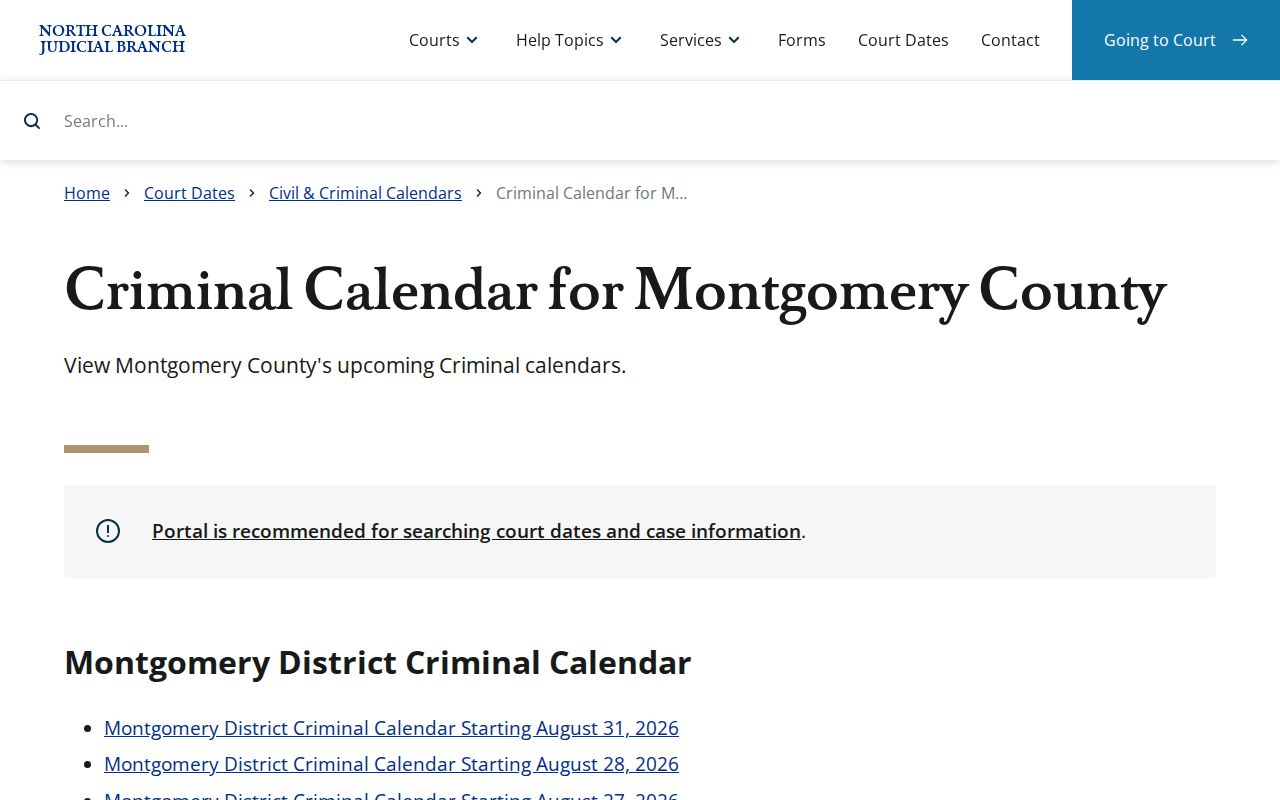
Pair the Montgomery County calendar with a Case Summary and Clerk confirmation. That combination matters most when a court date looks old, unclear, or missing from the docket.
Courts That Hold Criminal Dockets
Montgomery County runs two trial divisions rather than separate criminal clerks. District Court, District 28 hears misdemeanor criminal cases and infractions. Superior Court, District 28 takes felony cases. It also hears District Court misdemeanor and infraction appeals for trial de novo. Magistrates handle designated initial and limited functions within the state court system. The Montgomery County Clerk of Superior Court keeps the local records for both trial divisions.
That structure should guide any docket search. A felony belongs in the Superior Court context. A misdemeanor or infraction starts in District Court. Both Montgomery County divisions reach the same places. Those places are Portal Smart Search, the calendar routes, and the local Clerk counter. The Montgomery County court location lists both District 28 trial divisions. It also gives the county's clerk path in one spot.
North Carolina Superior Court information explains the felony trial-court role behind Montgomery felony Case Summaries.
The statewide Superior Court structure rounds out the Montgomery County location filter and the unified Clerk route. It does not create a different county search portal.
Montgomery Criminal Portal Fallback
When a Montgomery County criminal document is not online, keep the record number handy. Then ask the Montgomery County Clerk of Superior Court about the local file. The Clerk office sits in the Montgomery County Courthouse, 108 E. Main St., Troy. The official courthouse listing posts weekday hours of 8:00 a.m. to 5:00 p.m. It also lists a main number of (910) 571-3700. Public self-service terminals at clerk offices support Montgomery County criminal searches. Those cover defendant name, case number, victim, or witness name. For a historic paper-file question, this Montgomery County counter is the documented fallback.
Request paper files in the county where the case is located. The Montgomery County Clerk handles inspection, available copies, and certification. A CAPTCHA or browser problem is one more reason to use that route. Recheck the location and record number first. The statewide records form is not the normal path for a Montgomery County case file. NCAOC says it does not hold local court documents. It does not hold case information.
Judicial Branch records guidance walks through the Montgomery County terminal, paper-file, and clerk-copy alternatives.
Sealed Dockets and Public Access
Montgomery County public criminal records are open through the Portal and Clerk inspection only as far as law permits. Juvenile records never appear as ordinary public Smart Search results. A sealed or expunged case is not viewable online. Is a Montgomery County result restricted? Do not chase it with broader searches or a different account. Public document images can also drop protected identifiers through lawful redaction.
Portal is a free convenience view, not the official Montgomery County court record. The Montgomery County Clerk of Superior Court holds the case file and provides official copies. A missing Montgomery County result can stem from a restriction, a transfer, or a historical paper file. A simple search error can also hide a record. None of it is proof that a Montgomery County record never existed.
Public-access rules. G.S. 7A-109 requires the Montgomery County Clerk to maintain court records and generally permits inspection unless law bars access. G.S. 7B-3000 withholds juvenile court records from public inspection except as the statute allows. G.S. 15A-151 makes expunction files confidential under controlled disclosure rules.
Montgomery Criminal Clerk Access
Montgomery County publishes no separate criminal clerk, municipal docket, or online charge-search product. The one Montgomery County Clerk office covers the local fallback for Superior Court felonies, District Court misdemeanors and infractions, and related record questions. A quick call before a trip can confirm which record number, document, or certification you need. The official sources list no separate criminal-records line and no local criminal-copy form.
Copies and certifications are Clerk functions. Under G.S. 7A-308, the baseline fee schedule sets $2.00 for the first copied page of a document. Each additional page or fraction costs $0.25. A certificate under seal is $3.00. Ask the Clerk for the total before sending payment. The official listings name no Montgomery County criminal document fee and no expedited-processing fee. The Clerk must confirm which copy and certification components apply to your request.
Note: An official Montgomery County copy comes from the Clerk's record; the Portal Case Summary remains a public, nonofficial lookup view.